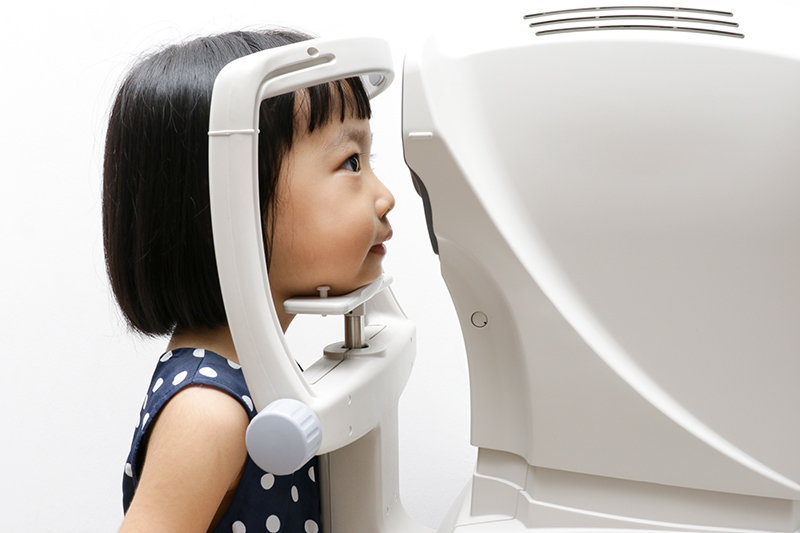

Finding out that your child needs a stronger prescription again can raise concerns, particularly when their glasses were only recently updated. Myopia can progress as the eyes grow during childhood, and repeated changes in prescription may indicate that your child’s myopia is continuing to progress.
In this article, we explain why your child’s myopia prescription may change quickly, what can influence its progression and when myopia control may be considered.
Key Takeaways
- Myopia can progress as a child’s eyes continue to grow and develop
- An earlier onset of myopia can allow more time for progression during childhood
- A stronger prescription corrects blurred vision but does not necessarily slow myopia progression
- Myopia control strategies may be considered when a child’s short-sightedness continues to increase
Why Does Myopia Progress During Childhood?
Myopia, or short-sightedness, occurs when the eye grows too long from front to back, causing light to focus in front of the retina rather than directly on it. As the eye continues to lengthen during childhood, the degree of myopia can increase and stronger prescriptions may be required.
Myopia often progresses throughout the growing years before stabilising in the later teenage years or early adulthood. Children who develop myopia at a younger age have a longer period for progression, increasing their likelihood of developing higher levels of short-sightedness.
What Can Influence Myopia Progression?
There is no single factor that determines how quickly a child’s myopia progresses. Progression can be influenced by factors such as the age at which myopia develops, family history and aspects of the child’s visual environment and lifestyle. Assessing these factors alongside changes in refraction over time can help an eye specialist understand a child’s risk of further progression.
Family History
Children with myopic parents have an increased likelihood of developing myopia. Family history can therefore provide useful context when evaluating your child’s risk and progression.
Time Spent Outdoors
Spending more time outdoors during childhood is associated with a lower risk of developing myopia and is an important part of healthy visual habits. However, the evidence for outdoor time alone slowing the progression of established myopia is less consistent, so children who already have myopia may also require regular monitoring and other myopia management strategies when appropriate.
Prolonged Near Work
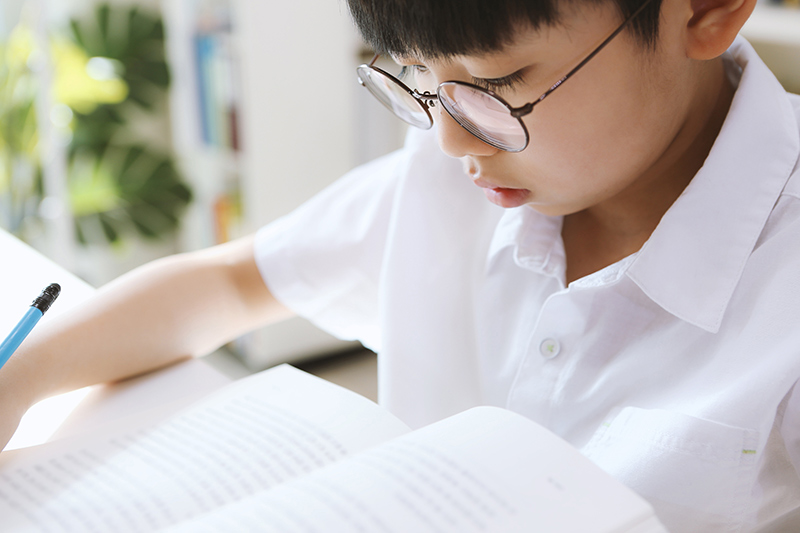
Reading, studying and using digital devices involve near work, but the relationship between near work and myopia is complex and has not been shown to be a simple cause-and-effect relationship. Very close reading distances and prolonged periods of continuous near work have been associated with a higher likelihood of myopia. Encouraging regular breaks, avoiding very close working distances and spending sufficient time outdoors can form part of healthy visual habits for children.
When Should Your Child See a Myopia Specialist?
Changes in your child’s prescription should be considered alongside how well they are seeing and functioning between eye checks.
Consider arranging an evaluation if:
- Your child has difficulty seeing the board at school
- They frequently squint to see distant objects
- They move unusually close to screens or the television
- They complain of headaches or visual discomfort
- Their vision appears to have changed since their last eye examination
Regular follow-up is also important once myopia has been identified. Tracking changes over time allows your child’s myopia specialist to determine whether their current vision correction remains appropriate and whether additional management should be considered.
Managing Childhood Myopia with Dr Leo Seo Wei
A changing prescription is not simply about needing another pair of stronger glasses. When increases occur repeatedly, looking at the pattern over time can help determine whether your child’s myopia is progressing at a rate that warrants additional management.
At Dr Leo Adult & Paediatric Eye Specialist Clinic in Singapore, Senior Consultant Ophthalmologist Dr Leo Seo Wei provides personalised care for childhood myopia. Drawing on more than 20 years of clinical experience and a special interest in myopia control, Dr Leo tailors management to each child’s vision, eye health and individual needs.
Schedule a consultation to discuss your child’s changing prescription and whether myopia control may be appropriate.
FAQs About Myopia Progression
Does my child need new glasses every time the prescription changes?
Not every small prescription change automatically requires new glasses. The decision depends on the degree of change, your child’s vision and whether their current spectacles still provide appropriate correction.
Can myopia progression be completely stopped?
Myopia control aims to slow progression rather than guarantee that your child’s prescription will stop changing. Continued follow-up helps determine how their myopia is responding and whether management needs to be adjusted.
Will my child still need glasses during myopia control?
In most cases, yes. Myopia control and vision correction serve different purposes, so your child may still require spectacles or another form of optical correction to see clearly while progression is being managed.